Compound Interest Explained: Why Starting Early Beats Saving More
There's a number that quietly decides how comfortable your sixties will be, and most people meet it far too late. It isn't your salary. It isn't even how much you save. It's how long your money has been growing — because compound interest doesn't reward the biggest saver, it rewards the earliest one. A twenty-two-year-old putting away modest amounts routinely ends up ahead of a thirty-five-year-old saving twice as much, and the gap isn't small. It's often hundreds of thousands. This post explains what compounding actually is, why the maths feels so counterintuitive that even smart people underestimate it, the handful of variables that genuinely move the needle, and where the whole beautiful idea has limits nobody advertises. Along the way you can test any of it yourself with our free Compound Interest Calculator.
Simple interest, and why nobody gets rich on it
Start with the boring version. Simple interest pays you a fixed percentage of your original deposit, every year, forever. Put $10,000 somewhere paying 7% simple interest and you earn $700 this year, $700 next year, and $700 in year thirty. After thirty years you have your $10,000 plus $21,000 of interest: $31,000. That's fine. It's also linear, and linear growth is not what builds wealth.
Compound interest changes exactly one thing: the interest you earn starts earning interest too. Year one you make $700, and now you have $10,700 working for you. Year two, 7% of $10,700 is $749 — you made $49 you didn't earn last year, purely because last year's interest went to work. It sounds trivial. Run it for thirty years and that same $10,000 becomes roughly $76,000, not $31,000. Same deposit, same rate, same three decades — and more than double the money. Nothing changed except that the interest was allowed to stay and multiply.
Why your brain gets this wrong
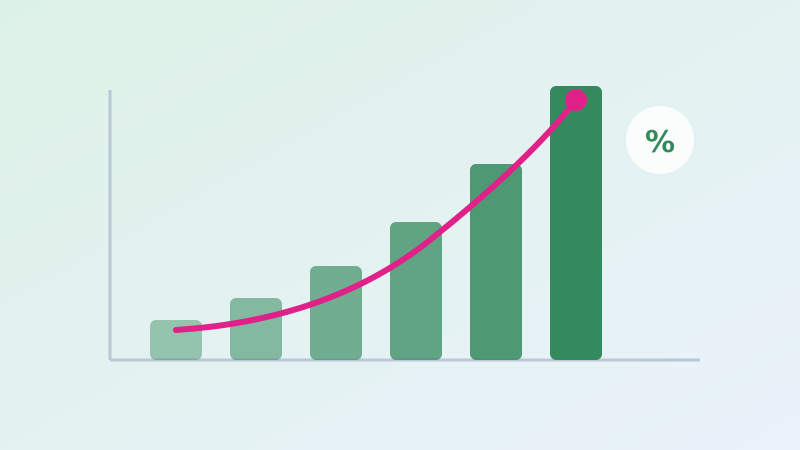
Human intuition is built for straight lines. Ask someone to guess what $10,000 at 7% becomes in thirty years and most people will land somewhere near $30,000–$40,000 — they instinctively extrapolate linearly. The real answer nearly doubles their guess, and this isn't a failure of intelligence: exponential curves genuinely look flat for a long time before they turn. That flat stretch at the beginning is where most people quit, because five years of saving produces returns that feel embarrassingly ordinary. The curve's payoff is loaded almost entirely into its final third. If you abandon the process during the boring years, you never see the years that were the whole point.
There's a classic illustration: a chessboard where you place one grain of rice on the first square and double it on each subsequent square. By square 20 you have about a million grains — impressive but manageable. By square 64, you'd need more rice than has been grown in human history. Nothing changed except that doubling kept happening. Compounding is that mechanism, running at a gentler rate, on your savings.
The four dials that actually matter
Every compounding outcome is governed by four inputs, and they are emphatically not equally important.
Time is the tyrant. It's the exponent in the equation, which is a mathematical way of saying it does more work than everything else combined. Consider two savers, both earning 7%. Anna invests $200 a month from age 25 to 35 — ten years, $24,000 total — then stops completely and never adds another dollar. Ben starts at 35 and invests $200 a month for thirty years, until 65 — $72,000 total, three times Anna's contribution. At 65, Anna has roughly $340,000. Ben has roughly $245,000. Anna contributed a third as much and finished nearly $100,000 ahead, and the only thing she did differently was start ten years earlier. This example gets repeated in finance books because it's so hard to believe.
Rate is powerful but treacherous. A 2% difference in return sounds cosmetic and is anything but: over thirty years, $10,000 at 5% becomes about $43,000, while at 7% it becomes about $76,000. Nearly double, from two percentage points. This is why fund fees matter so violently — a 1.5% annual fee doesn't cost you 1.5% of your final total, it compounds against you for decades and can quietly consume a quarter or more of your lifetime returns. Just as importantly, higher advertised rates almost always carry higher risk, and a rate you panic-sell out of is worth nothing.
Contributions are the dial you fully control. You cannot summon a better market, and you cannot get back the decade you didn't start. You can decide to add $50 more per month. Regular contributions also smooth out the terrifying part of investing — you buy at high prices and low prices alike, which historically has been far kinder to ordinary savers than trying to time entries.
Compounding frequency is the dial nobody should lose sleep over. Interest compounded monthly beats annually, and daily beats monthly — but the differences are small. On $10,000 at 7% for a decade, moving from annual to monthly compounding adds roughly a few hundred dollars. Worth having, not worth agonizing over. Marketing that leads with "compounds daily!" is drawing your attention to the least important variable.
Watching the curve turn: a worked example
Numbers make this concrete. Suppose you invest $5,000 today and add $300 every month, earning 7% annually. Where does the money come from at each stage?
After 5 years you've contributed $23,000 and have about $28,500 — interest accounts for roughly 19% of the balance. It feels underwhelming. After 10 years, contributions of $41,000 have become about $61,000; interest is now a third of the total. After 20 years, you've put in $77,000 and hold about $167,000 — more than half your balance is now money you never earned at a job. After 30 years, contributions of $113,000 have grown to roughly $390,000, and interest makes up over 70% of everything you own. In the final five years alone, your balance grows by more than you contributed in the entire first fifteen years. That's the curve turning, and it turns only for people who stayed.
Run your own version in the Compound Interest Calculator — change the start age by five years in either direction and watch what happens to the final number. It's the single most persuasive financial exercise there is, and it takes about ten seconds.
Compounding is not on your side when you borrow
The same mathematics that quietly enriches a patient saver quietly impoverishes a revolving borrower — it simply points the other way. Credit card interest compounds against you, typically daily, often above 20% APR. A $5,000 balance at 22%, paid at the minimum, can take well over a decade to clear and cost more in interest than the original purchase. This is why the standard advice to clear high-interest debt before investing isn't moralizing; it's arithmetic. Paying off a card charging 22% is a guaranteed, tax-free 22% return, and no investment offers that with certainty. Our Credit Card Payoff Calculator shows the real timeline, and the Loan Payoff Calculator does the same for installment debt.
The three things that quietly eat your curve
Inflation is the tax nobody legislates. If your money grows at 7% while prices rise at 3%, your real return is roughly 4% — still excellent, but your $390,000 in thirty years will buy what about $160,000 buys today. This isn't an argument against saving; it's a devastating argument against holding cash, which reliably loses purchasing power every year. Check what a sum will really be worth with the Inflation Calculator.
Fees, as noted, compound against you with the same relentlessness that returns compound for you. Over a working life, the gap between a 0.1% index fund and a 1.5% managed fund can amount to a house.
Interruptions are the most human problem. Compounding assumes the money stays invested. Every withdrawal doesn't just remove the sum taken — it removes everything that sum would have become. Taking $10,000 out at 30 doesn't cost $10,000; at 7% over thirty-five years, it costs you around $107,000 of future self. This is the strongest practical argument for a separate, boring emergency fund: it exists so that life's inevitable shocks never force you to raid the machine while it's running.
Turning the theory into a Tuesday-morning habit
None of this requires sophistication, and that's the good news. The behaviours that capture nearly all of compounding's benefit are dull: start now, even absurdly small — $25 a month started today beats $250 a month started in eight years for a surprisingly long stretch of your life, and it builds the habit while the stakes are low. Automate the contribution so it leaves your account before you can have an opinion about it. Raise the amount whenever your income rises, since a raise you never see is a raise you never miss. Keep costs brutally low. And above all, do not interrupt it — the market will fall, sometimes horribly, and the saver who does nothing during those falls consistently outperforms the saver who acts. Set a number goal and track it with our Savings Goal Calculator; watching a target approach is far better fuel than willpower.
Where compounding stops being magic
Honesty demands the caveats, because compound interest is often sold with the enthusiasm of a religion. The 7% figure that populates every example is a long-run historical average of a diversified stock market, not a promise, and it is not what your savings account pays. Real returns arrive as a violent zigzag: your money may sit below its starting value for years at a stretch, and average returns only exist over long periods. Compounding also does nothing for money you need next year, since short horizons remove the exponent that made it powerful — for anything under about five years, safety beats growth. And a spreadsheet's assumption of constant returns is, always, a polite fiction. What survives all these caveats is the core structural insight, and it survives intact: over long horizons, time in the market and cost control dominate almost everything else you might worry about.
Quick FAQ
What return rate should I use in a calculator? For long-run diversified stock investments, 6–7% after inflation is a common historical planning assumption; some use 8–10% before inflation. Savings accounts and bonds are far lower. Run the numbers at several rates rather than trusting one — the range is the honest answer.
Is monthly compounding worth switching accounts for? Rarely. The rate and the fees matter enormously; the frequency contributes a rounding error by comparison.
I'm 45 — is it too late? No, and the framing is wrong. Twenty years is a long compounding runway; the person who starts at 45 dramatically outperforms the person who starts at 55, exactly as the 25-year-old outperformed them. The best day to start was earlier. The second-best is today, and that has never once stopped being true.
Should I pay off debt or invest? As arithmetic: pay down anything charging more than your expected investment return — that's a guaranteed return you cannot get elsewhere. Below that, it's a judgment call involving your sleep quality, which is a legitimate financial variable.
Compound interest is the closest thing personal finance has to a free lunch, and its only price is patience — paid up front, in years, before any of the reward arrives. You cannot control markets, and you can't undo the decade you didn't start. What you can do is start the clock today and refuse to stop it. Open the free Compound Interest Calculator, put in a number you could actually save this month, and see what thirty years does to it. That number is not a fantasy — it's just arithmetic that hasn't happened yet.