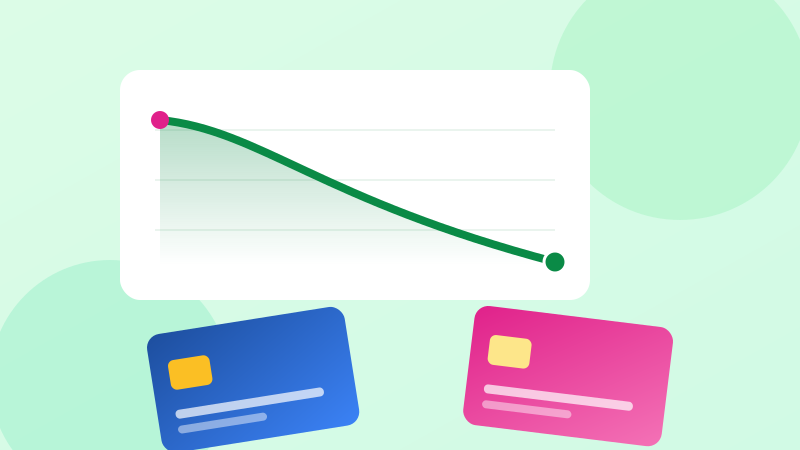
The Real Math Behind Paying Off a Loan Early
Here is a fact that surprises almost everyone the first time they see their loan statement: in the early years of a typical loan, most of your monthly payment doesn't reduce what you owe. On a fresh 30-year mortgage, well over half of each payment can be pure interest. You send hundreds of dollars a month, and the balance barely moves. It feels like a scam. It isn't — it's amortization, and once you understand how it works, you can turn the same math to your advantage.
How a fixed payment actually gets split
An amortized loan charges interest on the remaining balance, recalculated every month. Each payment first covers that month's interest; only what's left over reduces the principal. Early in the loan, the balance is at its largest, so the interest charge is at its largest, so the leftover is at its smallest. As the balance falls, the interest portion shrinks and the principal portion grows — slowly at first, then faster, until the final payments are nearly all principal.
Take a concrete example: $20,000 borrowed over five years at 8%. The fixed payment works out to about $406 a month. In month one, the interest charge is $20,000 × (8% ÷ 12) ≈ $133 — so only about $273 of your $406 actually reduces the debt. By the final year the proportions have flipped, but by then you've already paid most of the interest you were ever going to pay. Across the full five years, the total interest comes to roughly $4,300 — more than a fifth of what you borrowed. You can reproduce these exact numbers in our EMI / Loan Calculator, which uses the same standard amortization formula lenders use.
Why extra payments punch above their weight
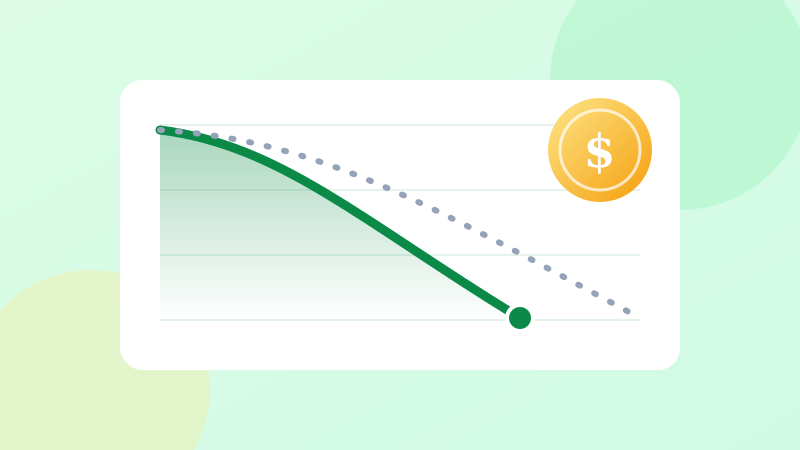
Now the useful part. Any extra money you send goes entirely to principal — there's no interest charge attached to it, because that month's interest was already covered by the regular payment. And a smaller principal doesn't just mean less debt; it means every future month's interest charge is calculated on a smaller number. One extra payment quietly reduces the interest portion of every payment that follows. The effect compounds in your favor, month after month, for the remaining life of the loan.
This is why the results from our Loan Payoff Calculator often look too good to be true. Using the loan above: adding just $100 a month cuts the payoff time from 60 months to around 46 and saves roughly $1,000 of interest. The calculator simulates the loan month by month — charging interest on the live balance, applying your payment, repeating — first at your current payment and then with the extra, and reports the difference in both months and dollars. No sleight of hand; just the same arithmetic running twice.
The same force, pointed the other way
The mechanism that works against you in a loan works for you in savings. Compound interest on an investment is amortization's mirror image: your balance earns a return, the return joins the balance, and next period's return is calculated on the larger number. Our Compound Interest Calculator simulates this the same way — month by month, with optional regular contributions — and the pattern it reveals is identical in shape: slow at first, then increasingly steep. $1,000 at 7% compounded monthly becomes about $2,010 in ten years without you adding a cent; keep contributing $100 a month and it passes $19,300. (For contrast, our Simple Interest Calculator shows what happens when returns don't compound — the difference between the two curves is the entire argument for starting early.)
Where the money should go first
Understanding both sides of the math leads to a practical question: should spare cash go toward the loan or into savings? The honest answer is that it depends on the interest rates on each side, your tax situation, whether your loan has prepayment penalties, and whether you have an emergency fund at all — which is why we won't pretend a calculator can decide it for you. What the calculators can do is put real numbers on each option: run your actual loan through the payoff tool, run the same monthly amount through the compound interest tool at a realistic return, and compare. People are routinely surprised by which side wins for their specific numbers — and surprised in both directions.
Watching the whole picture
Loan math doesn't live in isolation. A few companions on this site round out the picture. The Budget Planner answers the prior question — how much extra is actually available each month — by lining up income against expenses and updating live as you adjust. The Savings Goal Calculator flips the payoff question around: given a monthly contribution and an optional interest rate, when do you reach a target? And the humble Percentage Calculator handles the small supporting arithmetic — what percent of your income the payment represents, how much a rate drop of 1.5 points really changes things.
Three caveats, because honesty matters
- These are models. Real loans have fees, exact day-count conventions, and sometimes prepayment penalties that simple amortization doesn't capture. Our results will be very close, but your lender's statement is the authority.
- Rates change. The calculators assume a fixed rate. Variable-rate loans and realistic investment returns move around; treat outputs as scenarios, not prophecies.
- This isn't financial advice. The tools show you the arithmetic consequences of choices. Whether a choice is right for your life — taxes, risk tolerance, job stability — is a bigger question, and for large decisions a qualified professional is worth their fee.
If you want to feel the mechanics rather than just read them, try this five-minute experiment: put your real loan into the payoff calculator, then increase the extra payment in $25 steps and watch two numbers — months saved and interest saved. You'll notice the returns are strongest at the start and taper as the extra payment grows, because each additional dollar has slightly less future interest left to cancel. That shape, not any single figure, is the intuition worth keeping.
The banks understand this math perfectly; that's how they price the loan. The point of these tools is to put the same understanding on your side of the table — privately, in your browser, with your real numbers — so that the next time you look at a statement where the balance barely moved, you know exactly why, and exactly what to do about it.