How Credit Card Interest Really Works (and How to Beat It)
Here's a number that stops most people cold: on a $5,000 credit card balance at a typical interest rate, paying only the minimum each month can take well over fifteen years to clear — and cost you more in interest than the original $5,000 itself. You didn't buy anything twice. You just borrowed the money and let the clock run. Credit card debt is one of the few financial products designed, quite deliberately, to be easy to fall into and slow to climb out of, and the machinery that makes that true is mostly invisible on your statement. This post pulls it into the light: how the interest is actually calculated, why the minimum payment is a quiet trap, the two proven strategies for paying it all off, and how to use our Credit Card Payoff Calculator to see your own real timeline. No shame, no lectures — just the mechanics and a way out.
The number that matters: APR, and what it really costs per day
Your card has an APR — an Annual Percentage Rate — and it's usually a startling number, often somewhere around 20% or higher. But cards don't charge you once a year; most calculate interest daily. They take your APR, divide it by 365 to get a daily rate, and apply it to your balance every single day. A 22% APR becomes roughly 0.06% per day, which sounds trivially small until you remember it's charged on the whole balance, every day, and then charged again on the interest that was added — which brings us to the quiet villain of the whole story.
Compounding: the reason the balance seems to have a mind of its own
Compounding just means interest earning interest. On day one, you're charged interest on your balance. On day two, you're charged interest on your balance plus yesterday's interest. On day three, on all of that again. It's a snowball, except it's rolling in the wrong direction and it belongs to the bank. This is exactly the same force we celebrated in our post on paying off loans early — compounding is magnificent when it's working for you in a savings account, and merciless when it's working against you on a card. The difference between a friend and an enemy here is simply which side of the balance you're standing on. On a credit card, unless you clear the full statement balance, you're on the wrong side, and the interest quietly compounds against you month after month.
The grace period: the one window where cards are free
There's a genuinely important piece of good news buried in the fine print, and most people never use it fully. Nearly every card offers a grace period: if you pay your statement balance in full by the due date, you pay zero interest on purchases. None. During that window a credit card is an interest-free short-term loan and a fraud-protection layer rolled into one — a genuinely good deal. The trap springs the moment you carry a balance: once you don't pay in full, many cards revoke the grace period entirely, and new purchases start accruing interest immediately, from the day you make them, with no grace at all. That's the invisible cliff. The person who pays in full every month and the person who leaves "just a little" on the card are playing two completely different games with the same piece of plastic.
Why the minimum payment is designed to keep you paying
Look at any statement and you'll see a "minimum payment due" — often around 1% to 3% of your balance, plus that month's interest and fees. It feels responsible to pay it. It is barely anything at all. Because the minimum is calculated as a percentage of the balance, it shrinks as the balance shrinks, so the closer you get to done, the slower you go — like a runner whose legs get heavier the nearer they are to the finish line. Most of each minimum payment early on is just covering the interest, with only a sliver reducing what you actually owe. Regulators in many countries now force card statements to print a "if you only pay the minimum, it will take X years" box precisely because the answer is so alarming. On a mid-size balance, minimum-only payments routinely stretch past a decade and can more than double the total you repay. The minimum payment isn't there to help you finish; it's there to keep the account open and profitable.
The one insight that changes everything: pay more than the minimum
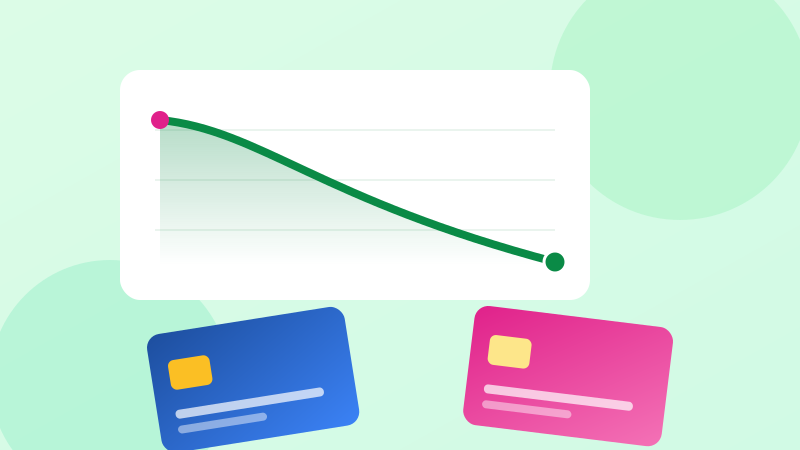
Here is the whole secret, and it's almost anticlimactically simple. Every dollar you pay above the minimum goes straight at the balance — none of it is eaten by that month's interest, which the minimum already covered. So extra payments are pure progress. This is why the timeline is so wildly sensitive to the amount you pay. Paying the minimum plus even a modest fixed amount each month doesn't shave a little off the payoff time; it can cut it by years and save you a huge share of the interest. The payoff calculator shows this vividly: type in your balance and APR, set the payment to the minimum, and watch it predict a grim decade-plus. Then nudge the monthly payment up by a small fixed amount and watch the years and the interest total collapse. Seeing that gap on your own numbers is often the exact motivation people need.
A fixed payment beats a shrinking one
There's a subtle, powerful trick hidden in that last point. Instead of paying the shrinking minimum, pick a fixed amount you can afford — say, whatever the minimum is this month — and keep paying that same fixed number every month, even as the balance falls and the "required" minimum drops below it. Because your payment stays constant while the interest portion shrinks, more and more of each payment attacks the principal, and the whole thing accelerates on its own toward the end. You didn't increase your budget; you just refused to let the payment shrink. It's one of the highest-return moves in personal finance, and it costs you nothing but the discipline to ignore the smaller "minimum due" the statement offers you.
Two proven strategies for multiple cards: snowball vs avalanche
If you're carrying balances on several cards, you need an order of attack, and there are two well-known methods. Both say the same first thing: pay the minimum on every card so nothing goes delinquent, then throw every spare dollar at just one card until it's dead, then roll that freed-up money onto the next. Where they differ is which card you kill first.
The avalanche method says: attack the card with the highest interest rate first, regardless of balance. This is mathematically optimal — it always saves you the most money and time, because you're starving the most expensive debt first. If you're motivated by numbers and want the objectively cheapest path, this is it.
The snowball method says: attack the card with the smallest balance first, regardless of rate. Mathematically it costs a little more. Psychologically, it's often the winner — because you clear an entire card quickly, get a real, visible victory, and that momentum ("snowball") keeps people going when spreadsheets alone wouldn't. Studies of actual human behavior suggest people who use the snowball method are more likely to stick with it and become debt-free, precisely because motivation, not math, is usually the thing that breaks first.
Balance transfers and consolidation: useful tools, sharp edges
You've probably seen offers for 0% balance transfer cards — move your balance to a new card and pay no interest for, say, 12 to 21 months. Used well, this is genuinely powerful: for that window, 100% of every payment attacks the principal, and you can make enormous progress. But read the edges carefully. There's almost always a transfer fee (commonly 3–5% of the balance) charged up front. The 0% rate is temporary, and whatever balance remains when it ends reverts to a normal high APR — so the plan only works if you realistically clear most of it during the promo window. And a new card can tempt new spending, which defeats the entire purpose. A balance transfer is a genuine opportunity, but it's a tool for the disciplined, not an escape hatch. Run the remaining balance and the post-promo rate through the calculator before you commit, so the "what happens when 0% ends" question has an answer before it becomes a surprise.
How to actually build your payoff plan, step by step
Enough theory — here's the plan we'd actually run. First, gather the real numbers for each card: current balance and APR. Guesswork won't do; get the statements. Second, open the Credit Card Payoff Calculator and enter your largest or highest-rate card with the minimum payment, just to see the sobering baseline — that number is your motivation. Third, figure out the largest fixed monthly payment you can genuinely sustain, and re-run the calculator with it; note how many years and how much interest you just erased. Fourth, if you have multiple cards, pick your method — avalanche for lowest cost, snowball for momentum — and commit to paying that fixed amount on the target card while paying minimums on the rest. Fifth, and most importantly, stop adding new purchases to the cards you're paying down. You cannot bail out a boat while drilling new holes in it; switch to a debit card or cash for daily spending until the balances are gone. Finally, each time a card hits zero, roll its entire payment onto the next one and feel the acceleration. That rolled-forward momentum is what turns a slow grind into a finish line that rushes toward you.
The mindset that makes it work
Two things are worth saying plainly, because the numbers alone don't capture them. First: carrying credit card debt is extraordinarily common and it is not a moral failing — cards are engineered by very smart people to be easy to lean on, and leaning on one during a hard month is a normal human thing to do, not a character flaw. Guilt tends to make people avoid looking at the statements, which is the one thing that guarantees the problem grows. Looking clearly is the brave move, and you're doing it right now. Second: the math, once you see it, is genuinely on your side. The same compounding that felt like a trap becomes an engine the instant you're paying more than the interest — every extra dollar today saves you multiple dollars of future interest, which is one of the best guaranteed returns available anywhere. Paying down a 22% card is, in effect, a risk-free 22% return on your money. No investment reliably offers that.
Where to go next on this site
Credit card payoff sits inside a wider financial toolkit. Once the cards are gone, the same monthly amount can start working for you — see what it becomes in the Compound Interest Calculator, where that former debt payment turns into a growing balance instead of a shrinking one. For bigger borrowing, the Mortgage & Loan Calculator uses the same amortization math, and our post on the real math behind paying off a loan early is the natural companion read to this one. If you're rebuilding a budget around the payoff plan, the Budget Planner gives every dollar a job.
And the usual honest note: everything here is general education, not personalized financial advice, and every tool on ComeTool runs entirely in your browser — your balances and rates are processed on your own device and never sent anywhere, because your debts are nobody else's business. For advice tailored to your full situation, a non-profit credit counselor or a qualified financial adviser can help, and reputable ones exist in most countries at low or no cost. But the first, free, powerful step is simply to see your real payoff timeline in black and white — and then to pay a little more than they ask you to. That single habit, repeated, is how the whole thing ends.