How Currency Exchange Rates Actually Work (and Where Your Money Goes)
You check a rate online, it says one euro buys 1.09 dollars, and you feel briefly informed. Then you land at the airport, hand over €200, and receive $196 instead of the $218 the internet promised. Somebody took $22 and nobody handed you a receipt explaining who. Exchange rates are one of those subjects that everyone brushes against — on holiday, buying from a foreign website, receiving payment from an overseas client — and almost nobody has ever had explained properly. This post fixes that: what a rate actually is, who sets it (nobody, and everybody), why the number you see is never quite the number you get, what really moves currencies over days and decades, and how to stop quietly losing money on every conversion. Any number here you can test live with our free Currency Converter.
A price, not a fact
The first thing to internalize is that an exchange rate is a price, exactly like the price of coffee or copper. It is not decreed by a government, not calculated from some ledger of national wealth, and not fixed in any book. For most major currencies it emerges, second by second, from the largest market on earth: roughly seven to eight trillion dollars change hands daily on the foreign exchange market, dwarfing every stock exchange combined. What you see quoted as "EUR/USD 1.09" is simply the price at which euros and dollars most recently traded between banks in serious size. It's a snapshot of a negotiation involving millions of participants, and it's already slightly out of date by the time you read it.
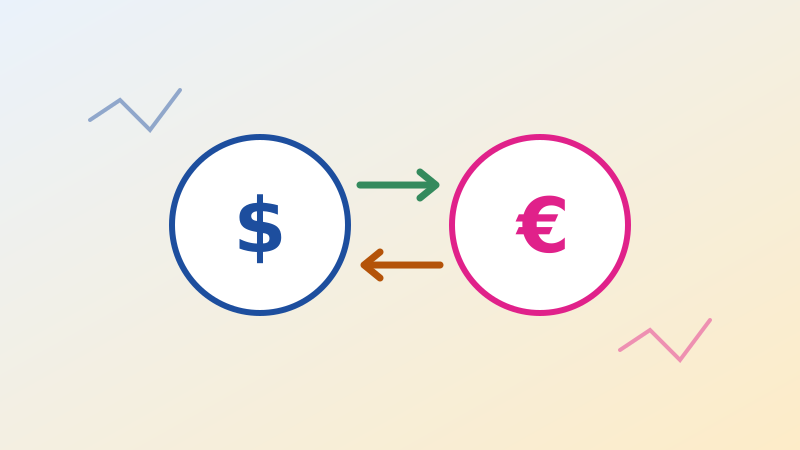
Quotes are always pairs, and the order matters. In EUR/USD = 1.09, the first currency (EUR) is the base and the second (USD) is the quote: one euro buys 1.09 dollars. Flip it and you get USD/EUR ≈ 0.917 — one dollar buys 0.917 euros. The two are reciprocals of each other, and confusing which direction you're going is the single most common error people make when converting in their heads. If a number looks suspiciously generous, you have probably inverted the pair.
Floating, pegged, and managed: three ways a currency can live
Floating currencies — the dollar, euro, pound, yen, Swiss franc, Australian dollar — are worth whatever the market says today. Nobody promises a value; supply and demand negotiate it continuously. Most of the world's trade runs on floating currencies, and they can move several percent in a week without anything scandalous having happened.
Pegged currencies are locked to another currency at a fixed rate by their central bank. The Hong Kong dollar tracks the US dollar within a tight band; several Gulf currencies are pegged to it outright. Pegs buy stability and predictability for trade, but they cost independence: a country with a peg effectively imports the monetary policy of the country it's pegged to, and defending a peg during a crisis can drain a nation's reserves catastrophically. Pegs have broken, spectacularly, more than once in living memory.
Managed floats sit between: the currency largely floats, but the central bank intervenes — buying or selling its own currency — when moves get disorderly. Many large emerging economies operate this way, and the intervention is often quiet rather than announced.
Where your money actually goes
Now the airport. You were promised 1.09 and got the equivalent of 0.98. That 10% didn't vanish into the ether; it was harvested in three places, and only one of them is usually labelled.
The spread markup is the big one, and it's invisible by design. A bureau doesn't charge you a fee — it simply gives you a worse rate than the mid-market one, keeps the difference, and advertises "0% commission" with a completely straight face. Airport bureaus routinely mark up 7–12%. Hotel desks can be worse. It is the most expensive money you will ever buy, sold in the place where you have the least ability to walk away.
Explicit fees — a flat charge per transaction, or a percentage — at least have the decency to appear on a screen. Banks often layer these on top of an already marked-up rate.
Dynamic currency conversion is the one that catches even careful travellers. You pay by card abroad, and the terminal cheerfully offers to charge you "in your home currency" so you know exactly what you're spending. Say yes and the merchant's payment processor performs the conversion at a rate they invented, typically 3–6% worse than your own card network's. Always choose to be charged in the local currency. Your bank's rate will almost always beat the terminal's, and this one habit saves more money than any other on this page.
What actually moves a currency
Over a day, currencies move on news, positioning and noise, and nobody honestly predicts that. Over months and years, a few forces dominate.
Interest rates are the loudest. Money flows toward yield: if one central bank raises rates while another holds, capital tends to move toward the higher-yielding currency, pushing its value up. This is why exchange rates lurch on central bank announcements, and why markets obsess over the exact wording of statements about future policy — the expectation of a rate change moves the currency long before the change occurs.
Inflation works in the opposite direction over the long run. A currency losing purchasing power at home tends to lose it abroad; sustained high inflation is corrosive to a currency's value. This is the intuition behind purchasing power parity — the theory that identical goods should eventually cost the same everywhere once converted — which is a poor short-term predictor and a surprisingly decent long-term one.
Trade and capital flows matter mechanically: a country exporting more than it imports has foreigners buying its currency to pay for goods. Foreign investment does the same.
Political stability and risk appetite supply the drama. In genuine global panic, money stampedes toward currencies perceived as safe — historically the dollar, yen and Swiss franc — regardless of their fundamentals. A currency can strengthen during a crisis simply because frightened capital wants somewhere to sit.
How to convert without being fleeced
The practical rules are few and boring, which is how you know they work. Know the mid-market rate before you transact — this is your only defense, because every provider's cost is simply the distance between their rate and that one. Check it in the Currency Converter before you're standing at a counter. Never convert at airports, ports, or hotels unless you need a bus fare. Always decline dynamic currency conversion and pay in the local currency. Use a card with no foreign transaction fee if you travel more than rarely; the annual saving usually exceeds any card fee. For large transfers — property, tuition, salary — the difference between a high-street bank and a specialist transfer service on a $50,000 transfer can exceed $1,500, so it is worth an hour of comparison. And withdraw cash in larger, less frequent amounts, since flat ATM fees hurt small withdrawals disproportionately.
Doing the mental arithmetic like a local
You don't need precision while shopping; you need to not be fooled. Round the rate hard and pick a direction. If a euro is about 1.09 dollars, then euros are "dollars plus a tenth" — a €40 dinner is about $44. If a dollar is about 150 yen, then yen prices are "divide by 150," so ¥3,000 is around $20. Practise the one conversion you'll use most before you travel and you'll shop with actual confidence rather than the queasy sense of spending Monopoly money that leads to overspending. For the exact figure, the converter handles it, and if you're budgeting a trip, the Percentage Calculator makes the "how much worse is this rate than mid-market?" question a five-second job.
A note on volatility, and why you shouldn't try to time it
Everyone who has ever converted money has thought about waiting for a better rate. It's a tempting game and a very old one, and the honest evidence is that it's close to unwinnable for ordinary people. Currency movements over short horizons are dominated by professional traders reacting to information seconds after it appears — the rate has usually already moved by the time a story reaches you. For meaningful sums with a real deadline, the sensible approaches are unglamorous: convert when you need it, or split a large conversion into a few tranches over time so you average out rather than betting everything on one day. Trying to outguess the largest, fastest market on earth with a phone and a hunch is not a strategy; the person who calmly avoided a 5% airport markup has already beaten the person who waited three weeks for a 1% improvement.
The rates that never make the news
Beyond the headline pairs, a few quirks of the system shape everyday life in ways worth knowing. Cross rates are what you get when neither currency is the dollar: converting Norwegian kroner to Thai baht usually routes through USD behind the scenes, meaning you pay a spread twice rather than once. That's why exotic pairings feel disproportionately expensive, and why splitting an unusual conversion across two obvious steps rarely helps — you're already doing it. Weekend gaps matter too: the forex market effectively closes from Friday evening to Sunday evening, and providers who quote you a rate on Saturday are quoting Friday's close plus a cushion against whatever Monday brings. Cash rates are always worse than electronic rates, because physical banknotes must be stored, insured, counted and shipped, and that cost lands on the customer buying paper money. And rounding is not neutral: providers who round to convenient figures reliably round in the direction that favours themselves, which on small transactions can quietly exceed the visible fee.
None of these are scandals. They are the plumbing of a system that moves trillions daily with remarkable reliability. But knowing they exist converts you from someone who feels vaguely cheated into someone who can point at exactly which line cost them money — and that is the entire difference between paying a fair price and paying whatever was on the sign.
Quick FAQ
Why do different websites show slightly different rates? Because they source from different providers, at different moments, and some quietly bake in a margin. The mid-market rate is the neutral reference; anything meaningfully off it includes someone's profit.
What is the "spread," in plain words? The gap between what a dealer pays for a currency and what they sell it for. It's how currency exchange makes money without calling anything a fee.
Is it better to take cash or use a card abroad? For most travellers, a fee-free card charged in the local currency beats carrying cash, with a small amount of local cash for places that don't take cards. The worst option, reliably, is buying foreign cash at the airport.
Should I exchange money before I travel? A little, from a competitive provider, so you're not desperate on arrival. Never the bulk of your trip's money, and never at the airport counter.
Why is a "strong" currency not automatically good? A strong currency makes imports and foreign holidays cheaper for its citizens, but makes that country's exports more expensive abroad, which can hurt its manufacturers. "Strong" is a description, not a verdict.
Exchange rates look intimidating because they're presented as weather — something that happens to you, unknowable and unfair. They're not. They're prices, set in a vast open market, and the only part that ever really costs you is the margin someone adds between the true price and yours. You now know exactly where that margin hides. Check the real rate before your next conversion with the free Currency Converter, decline the terminal's "helpful" offer to charge you at home, and keep the difference — it was always yours.