Sleep Cycles Explained: The Real Story Behind "Wake Up at the Right Time"
You know the ritual. It's 12:47 a.m., you're staring at the ceiling, and your brain fires up its least favorite calculator: if I fall asleep right now, I get six hours and thirteen minutes. Ten minutes later you run the math again, and somehow the answer is worse. Everyone does this, and almost everyone does it wrong — because the thing that decides how you feel tomorrow isn't just how many hours you get. It's where in a sleep cycle your alarm happens to go off. That's the entire idea behind our Sleep Cycle Calculator, and in this post we'll walk through what the science actually says, what the calculator can honestly promise you (and what it can't), and how to use it so mornings stop feeling like an ambush.
What a sleep cycle actually is
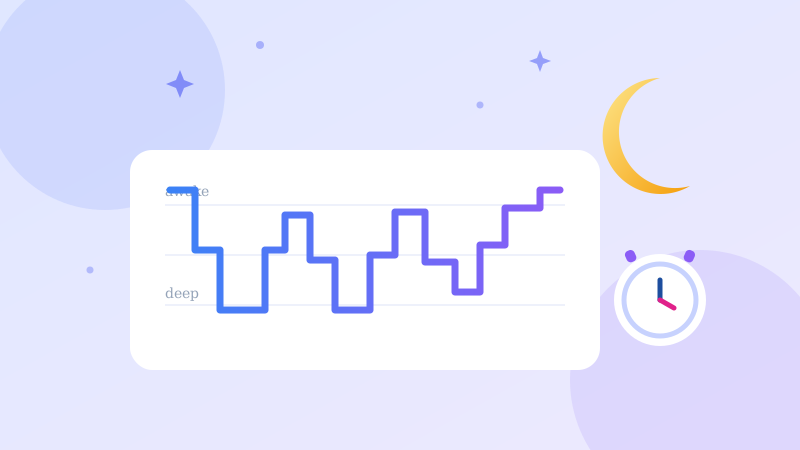
Sleep isn't one long, flat state — it's a repeating loop with structure, and each loop takes roughly ninety minutes. You drift in through light sleep (the drowsy, easily-woken stage where a car door outside can still pull you back), settle into deeper light sleep where your heart rate and temperature drop, then descend into deep sleep — the heavy, restorative basement of the night where your body does its repair work. After that, something strange happens: your brain climbs back up and switches into REM sleep, where most vivid dreaming lives and your brain activity looks almost like being awake, while your body stays effectively paralyzed. Then the loop starts over. A typical night strings four to six of these cycles together, back to back, like episodes of a series your brain insists on binge-watching every single night.
Here's the detail that makes the whole topic interesting: the cycles aren't identical. Early in the night, they're loaded with deep sleep — your body prioritizes physical restoration first. As the night goes on, deep sleep shrinks and REM expands, so your longest, richest dream sleep happens in the final cycles before morning. Keep that in mind; it explains a lot of what's coming.
Why waking up mid-cycle feels like being hit by a bus
If you've ever slept a full eight hours and still woken up feeling like you'd been dragged behind a truck, you've met sleep inertia — the groggy, disoriented fog that comes from being yanked out of the wrong stage. Wake up during light sleep and the transition is gentle; you were nearly at the surface anyway. But when an alarm detonates in the middle of deep sleep, your brain has to make an emergency ascent from its most disconnected state, and it does not do this gracefully. The fog can genuinely take a while to burn off — reaction time, memory, and mood all measurably suffer in the minutes (sometimes longer) after a bad-stage wake-up. This is why six well-timed hours can honestly feel better than seven and a half badly-timed ones. It isn't magic and it isn't discipline. It's just which floor of the building the alarm caught you on.
What the calculator actually does
The Sleep Cycle Calculator does the 12:47 a.m. ceiling-math properly, in both directions. Tell it when you need to wake up, and it counts backward in roughly 90-minute steps — five cycles, six cycles — and adds a buffer for the time it takes an average person to actually fall asleep (about fifteen minutes; more on that assumption later). Out come a handful of suggested bedtimes, each one landing your alarm near the end of a cycle rather than the middle of one. Or work forward: tell it you're going to bed now, and it suggests wake-up times that respect the same rhythm. Everything runs instantly in your browser, and — as with every tool on this site — nothing you enter is sent anywhere.
The honest caveat: ninety minutes is an average, and you are not an average
Now for the part most sleep-calculator websites conveniently skip. That famous 90-minute figure is a population average, not a law of physics. Real cycles run anywhere from about 70 to 110 minutes, they differ from person to person, and they even vary within a single night — your first cycle and your fifth aren't the same length. Age shifts them. Stress shifts them. Last night's sleep debt shifts them. So when the calculator says "go to bed at 10:52," what it's really offering is a well-reasoned estimate built on the average human, not a prophecy about you specifically. Anyone who tells you a free web tool can pinpoint your exact cycle boundaries is selling something. We'd rather tell you the truth: it's a smart starting point that beats guessing, and that's already worth a lot.
Where the 90-minute number even came from
It's fair to ask why "ninety minutes" is the figure everyone quotes. It traces back to sleep-laboratory research from the 1950s and 60s, when scientists first started wiring volunteers up to EEG machines and watching brain activity cycle through the night in a repeating pattern. Averaged across many sleepers, one full trip through the stages and back landed in the neighborhood of 90 to 110 minutes, and the round number stuck in the popular imagination the way round numbers always do. What often gets lost in the retelling is that those same studies showed enormous individual variation — the average was never meant to be a personal guarantee, just a useful central tendency. So the number isn't wrong or made up; it's a real finding that's been flattened into a slogan. Treating it as roughly-90-give-or-take is faithful to the science. Treating it as exactly-90-to-the-minute is not, and that's the line most sleep-calculator marketing quietly crosses.
What the math still gets right
With that caveat on the table, don't swing to the other extreme and dismiss the whole idea — the structure is real, and planning around it works better than ignoring it. Aiming for five complete cycles (about 7.5 hours of actual sleep) or six (about 9 hours) puts you inside the range where most adults genuinely thrive. Adding the fall-asleep buffer stops the classic mistake of counting time-in-bed as time-asleep. And targeting a cycle boundary, even imprecisely, raises your odds of surfacing from light sleep instead of the basement. Perfect precision? No. Meaningfully better mornings than picking a bedtime at random? For most people, yes — and that's the honest pitch.
Deep sleep and REM: why cutting the night short is sneakier than it looks
Remember how the night is front-loaded with deep sleep and back-loaded with REM? That has a consequence most people never connect: when you trim your night from eight hours to six, you don't lose 25% of everything evenly. Your deep sleep — parked safely in the early cycles — mostly survives. What gets amputated is the REM-rich final stretch, which is disproportionately where memory consolidation, learning, and emotional processing happen. That's why a run of short nights leaves you not just tired but weirdly foggy, irritable, and bad at remembering where you put things. You've been specifically starving the part of sleep that files your life away. The calculator's suggestion to complete whole cycles is quietly protecting those last, most fragile chapters of the night.
About that fifteen-minute assumption
The calculator assumes you take about fifteen minutes to fall asleep, because that's a healthy average. But this number is worth a moment of self-awareness, because it's diagnostic in both directions. If your head hits the pillow and you're gone in under five minutes — and it happens every night — that's not a superpower; it's usually a sign you're carrying real sleep debt. A well-rested brain takes a little while to power down. On the other end, if you routinely lie awake for forty-five minutes or more, mentally add that to the calculator's suggestion and go to bed earlier — and know that chronic long sleep latency is worth mentioning to a doctor, because it's one of the more treatable sleep complaints out there.
Larks, owls, and the tyranny of the 7 a.m. alarm
One more thing no calculator controls: your chronotype. Some people's internal clocks genuinely run early (the infuriating friends who feel great at 6 a.m.) and some run late — it's substantially built-in, not a character flaw. If you're a natural night owl squeezed into an early work schedule, cycle-timing helps you make the best of the hours you get, but it can't relocate your biology. What helps more than any single trick is consistency: going to bed and waking at roughly the same times daily, weekends included. The Saturday sleep-in feels like repayment, but shifting your schedule two hours back and forth every weekend gives your body a case of self-inflicted jet lag that Monday's alarm collects on. A consistent decent schedule beats an inconsistent perfect one, every time.
The nap corollary
The same cycle logic explains the ancient mystery of why some naps save your afternoon and others ruin your entire day. A 15–20 minute nap keeps you in light sleep — you surface easily, refreshed, with no fog. A full 90-minute nap lets you complete one entire cycle and wake at a natural boundary. But the 45-minute "compromise" nap is a trap: it's just long enough to drop you into deep sleep and then wakes you from the very bottom of it, which is why you emerge feeling like you've time-traveled to the wrong decade. Short or full-cycle. Never the murky middle.
Timing matters as much as length. A nap works best in the early afternoon, when there's a natural dip in alertness built into most people's body clocks — the post-lunch slump is real physiology, not just the sandwich. Nap too late in the day, though, and you borrow from the very deep-sleep pressure that's supposed to help you fall asleep at night, and the calculator's carefully-planned bedtime stops working because you're no longer tired when it arrives. If you're using the calculator to fix genuinely broken nights, it's worth being ruthless about afternoon naps for a couple of weeks so you can see the schedule working on its own terms first.
A practical playbook
Here's how we'd actually use the tool, start to finish. Fix your wake-up time first — it's usually the non-negotiable end of the equation. Run the calculator and pick the five- or six-cycle bedtime. Try it for two weeks, consistently, and judge the results the way you'd judge any experiment: by the trend, not by one rough Tuesday. If you're consistently groggy, slide your bedtime fifteen minutes in either direction — you're calibrating that population average to your personal cycle length, which is something only you can measure and only by feel. Pair it with the boring fundamentals that out-perform every hack ever invented: a dark cool room, caffeine cut off by early afternoon, screens dimmed before bed. If you like tracking habits, our Habit Tracker is a pleasantly low-tech way to keep a two-week sleep experiment honest.
What no calculator can see
Let's be plain about the boundaries. A sleep calculator arranges your schedule; it cannot inspect your sleep. It doesn't know that the 9 p.m. espresso is still circulating at 1 a.m., or that alcohol — which feels like it helps you fall asleep — quietly suppresses REM and fragments the second half of your night. It can't detect sleep apnea, restless legs, or the racing-mind insomnia that laughs at arithmetic. So one genuinely important paragraph: if you snore heavily, wake gasping, or feel exhausted every day despite spending enough hours in bed, that's not a scheduling problem and no bedtime calculator will fix it — that's a conversation with a doctor, and sleep medicine has real solutions. A tool should know what it's for, and this one is for timing, not diagnosis.
Where to go from here
Sleep sits in a neighborhood of numbers we've written about before. The Calorie Needs Calculator and BMI Calculator estimate other corners of the health picture — and our deep dive on BMI applies exactly the same philosophy as this post: use the number, know its blind spots. The Heart Rate Zone Calculator covers the exercise side, and exercise, not coincidentally, is one of the most reliable deep-sleep boosters known. For the whole family of these tools and their honest limits, What Fitness Calculators Really Tell You is the companion read.
And the standing reminders, because they're the point of this site: the sleep calculator runs entirely in your browser — your bedtime, your wake time, and your 12:47 a.m. anxieties are processed on your device and never sent anywhere. And nothing here is medical advice; it's arithmetic plus published averages, offered honestly. Use it to stop doing panicked ceiling-math at midnight. Use a professional for anything the math can't reach. Sleep well — properly, in complete cycles, starting tonight.